![]() |
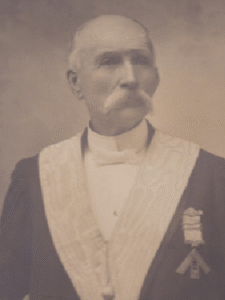
Ken Broomhead OAM, MAP, FRAeSPresentAwarded the OAM for His Services to the Aviation Industry |
|---|
Ken was brought up on his parents coffee plantation in the New Guinea Highlands.
His father had been there in the RAAF in World War Two, and was a member of MING (Masons In New Guinea).
Education at boarding schools was only negative aspect of life in New Guinea.
He married in 1968 and took his wife Annette (a medical practitioner) back to New Guinea. She became a medical officer there- a job not without its challenges. They had two daughters and four grandchildren.
Ken and his family moved to Australia to further his airline career, initially moving to Brisbane and then Melbourne in 1980 to take up the
opportunity of a command. Subsequently International Flying involved moving to Singapore. Regretfully the romance of International Flying has a downside, which was an almost constant time away from home.
He moved to Wangaratta upon his retirement from flying and wife’s illness, joining the Wangaratta lodge of St John at the first opportunity.
His partner Lili, who is with him today, cared for Annette late in her life.
Ken’s family have A long involvement with Freemasonry.
His great grandfather was a Mason and a ships Master on the UK Australia run in the 1850s and settled upon retirement in Geelong.
His Grandfather, also a Mason was Mayor of Glenelg during World War One. His two uncles were very involved, both spending time in Grand Lodge.
His uncle Ted was captured at Tobruk and subsequently wrote to book “Barbed Wire in the Sunset” which was used as informative material post war by the Atrocities Commission.
His other uncle (Doug) was a bomber pilot, who was shot down in August 1942 and spent nearly three years in the infamous Stalag Luft 3. A couple a points of interest are that he shared a room with Squadron Leader Kirby Green who was deputy chief of the “Great Escape” and was subsequently shot. a number of the navigators also in the camp, sparked an interest in the law in Doug which resulted in him becoming a successful Barrister after the war.
Masonic History
New Guinea had a large masonic community and Ken was Initiated Passed and Raised in Mount Hagen New Guinea Lodge number 508 of the Queensland constitution in 1968, the year his father was Worshipful Master. Ken is to this day a Life Member of that Lodge.
When possible he still visits New Guinea regularly to assist with the Installations.
He was Installed as Worshipful Master of Tamborine Lodge number 356 Queensland Constitution in 1980. His father being the Installing Master. Of interest, the Grand Lodge representative, Right Worshipful Brother Catt was a Judge in the Queensland judicial system.
Ken was Perfected in the 18th degree of the Ancient and Accepted Scottish Rite in 1978, this being in the English Constitution. His international
Flying provided great opportunities of visiting Chapters and Councils, the ritual being almost identical worldwide. He took up an almost full time involvement in Freemasonry after his working retirement and was granted 33rd degree rank upon taking up a 5 year commitment as District Commander NSW South Coast. This was completed recently and he is mightily looking forward to returning to the joys and challenges of Craft Masonry.
Work History
New Guinea was built on gold, coconut and coffee plantations and was very much a country built by aeroplanes. Ken commenced flying THERE in the 1960s in Missionary then Charter operations before flying the mighty DC3 around New Guinea as a co-pilot to war time captains, and to this day speaks of this as a highlight in his career.
He moved to Australia to further his airline career, initially based in Brisbane, then moving to Melbourne in 1980 to take up a command.
He flew most of the aircraft types in Ansett rising to Fleet Manager of the Boeing 747 aircraft, then moving to Singapore Airlines on the Boeing 777.
He was seconded to South America and Air New Zealand International during this period as part of management training.
He has maintained a life time interest in Flying Instruction and many happy years were had as a voluntary flying instructor with the RAAF Air Cadets mainly at Amberley in Queensland.
Ken was awarded the OAM for Services to the Aviation Industry. He is a Fellow of the Royal Aeronautical Society and A Master Air Pilot
![]() |
The Ven P.H. Dicker OBE1891 – 1975Canon of The Holy Trinity Church Wangaratta |
|---|
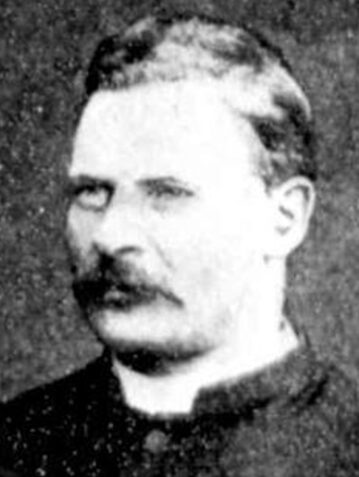
Percival Hensby Dicker OBE (1892-1975) aka Percy Hensby Dicker. Anglican Priest. Headmaster Boston House at Geelong Grammar. Canon Holy Trinity Church Wangaratta. Wangaratta Hospital has a ward named for him. Initiated into Moe Lodge No 210 (UGLV) on 7 May 1923. Also member of Bareena Lodge No 398 (WM 1930-31) & Wangaratta Lodge of St. John No 66 both UGLV
Reference
![]() |
George Handley1870 – 1943Mayor of The Borough of Wangaratta |
|---|
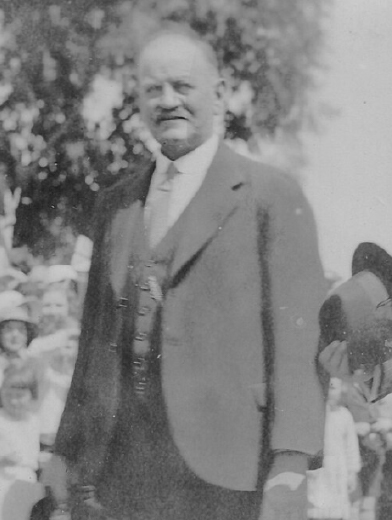
George Handley was Born in Melbourne, and was a fortnight old when with his parents moved to Wangaratta. He was for 25 years a councillor of the Wangaratta shire, occupying the presidential chair three times. For several years he was a councillor of the Borough of Wangaratta, and was Mayor on three occasions.
He was connected with may local organisations, and was one of the original members of the volunteer fire brigade. He is survived by his wife and the following family: Eric, Leslie and Grenville.
Ovens and Murray Advertiser – Wed 21 July 1943 MR. George Handley
![]() |
Norman McGuffie1895 – 1971Wangaratta Magpies Football Club Team of the Century Inductee |
|---|
Played 107 Games
Committee Member 1927-1962
Secretary/Treasurer 1935-1938
President 1949-1953 & 1959-1962
Life Member
WFNC Team of the Century
Enlistment date 31 January 1916
Rank on enlistment Private
37th Battalion, D Company
Unit embarked from Melbourne, Victoria, on board HMAT A34 Persic on 3 June 1916
Returned to Australia 30 January 1918
War Service: 900 days (657 days of which were spent abroad)
Reference
![]() |
Lieut. Colonel Frederick Wray CMG, CBE1864 –1943Anglican Clergyman and Military Chaplain |
|---|
Frederick William Wray (1864-1943), Anglican clergyman and military chaplain, was born on 29 September 1864 at Taradale, Victoria, sixth son of English-born Robert Mackie Wray, clerk, and his Irish wife Anne Rebecca, née Bury. Educated near Castlemaine, at 14 Fred joined the Victorian Volunteer Force and later the militia, serving a total of seven years. He was an undergraduate at Trinity College, University of Melbourne, in 1889-90 and decided to study for the Anglican ministry. Made deacon in 1894 and ordained priest on 22 December 1895 by Bishop F. F. Goe, Wray was minister at Dookie (1894-96) and Euroa (1896-1900). On 4 June 1897 he was appointed chaplain in the Victorian Military Forces.
An accomplished rower, marksman and Australian Rules footballer, the ‘sporting parson’—nearly six feet (183 cm) tall, weighing 15 stone (95 kg) and ‘a splendid type of a muscular Christian’—sailed as chaplain with Victoria’s 2nd (Mounted Rifles) Contingent and arrived in South Africa on 5 February 1900. The contingent saw action in the Cape Colony, Orange River Colony and the Transvaal, then returned to Melbourne in December. Two bouts of enteric fever delayed Wray’s repatriation until mid-1901. On 3 April 1902 he married Henrietta Olive Elizabeth Catford at Christ Church, Hawthorn. He resumed parish work, first at Yarrawonga (1902-13) and then at Rushworth, retaining his military appointment and gaining promotion to chaplain 2nd class in 1912.
On 1 December 1914 he joined the Australian Imperial Force and sailed for Egypt three weeks later. Allotted to the 4th Brigade, with particular responsibility for the 13th Battalion, he ‘slipped ashore’ at Gallipoli early on 26 April 1915 despite orders forbidding non-combatants from so doing. He became a familiar figure at the front line and earned the soldiers’ gratitude. A fellow chaplain described him ‘moving about in full view of the enemy’ with ‘a notebook and pencil in his hand … busy with the work of keeping a check on the names of the dead and a list of their personal effects’. On 3 May, after the 4th Brigade had suffered heavy losses, Wray described his duties: ‘During the day I did field dressing, stretcher bearing, grave digging and filling and putting the bodies in’. Suffering from enteritis in August, he was successively taken to Malta, England and finally to Rushworth. For his service at Gallipoli he was mentioned in dispatches and appointed C.M.G.
Rejoining the 4th Brigade in Egypt in March 1916, Wray accompanied the 13th Battalion on operations in the desert and was again mentioned in dispatches. In June the brigade transferred to the Western Front, taking part in the battles of Pozières and Mouquet Farm in August. As at Gallipoli, Wray moved among the troops, giving spiritual and practical support; once more his work included assistance at dressing stations, burying the dead, sorting effects such as identity discs and pay books, and writing to the bereaved. On 14 October he wrote a letter critical of his Church for not providing as chaplains ‘those specially fitted for work among men’. Posted in December as staff chaplain to Administrative Headquarters, A.I.F., London, he became senior chaplain early in 1917. Until his overseas service ended in August 1919, he administered chaplaincy affairs from London, making periodic visits to France. He was appointed C.B.E. in June.
Returning to civilian life, in 1920 Wray was appointed canon of Holy Trinity Cathedral, Wangaratta, and in 1928 rector of that parish. Erect and square-shouldered, he kept his soldierly bearing and traversed the Wangaratta area on foot or on a bicycle, never having learned to drive a motor car. He retained his interest in sport, and was active in the affairs of returned servicemen and in Freemasonry. Wray retired in 1935. Predeceased by his wife, he died on 18 November 1943 at his home in Sandringham, Melbourne, and was buried in the new Cheltenham cemetery. Two sons and three daughters survived him.
Reference
Australian Dictionary of Biography, Volume 12 , 1990, David Dexter
![]() |
Edward Coulson1844 – 1936Mayor of the City of Collingwood
|
|---|
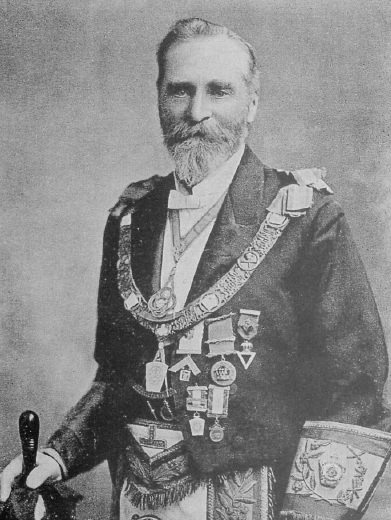
Edward John Coulson was born at Newcastle-on-Tyne, in England on the 7th of February 1844, and migrated to Australia at eighteen years of age. He arrived in Melbourne in 1862. Edward worked for several years in the Goulburn Valley and North-East Victoria. Firstly, the building of dams along the Goulburn River in the Shepparton area. Then as an agent for several transport companies in Everton, which is about halfway between Wangaratta and Myrtleford in the North-East of the State.
When the railway line reached Beechworth in 1876, Edward’s job as a transport agent was eliminated so he headed to Melbourne. He was then to establish himself as a Ship’s Chandler and Hops merchant in Flinders Lane for the next 30 years.
While working in Northern Victoria, he was initiated in the Wangaratta Lodge of St John in December 1874, passed in January 1875, and raised in March 1875. The initiation fee at that time was 5 Guineas ($850 by today’s prices). In 1902 he was appointed Representative of the Grand Lodge of Mark Master Masons of England and Wales, and that Grand Lodge conferred on him the rank of Past Grand Warden.
With the high degree of antagonism, self-preservation, laissez faire, and pettifogging shown in the three constitutions against the formation of a United Grand Lodge, Coulson acted as an individual, and circularised all Mark Master Masons, and in 1897 called a meeting at his own home. It was overwhelmingly agreed that a United Grand Lodge was needed. Coulson had himself been a Master in each of the three constitutions (English, Scottish, and Irish) so was in a peculiarly strong position to lead a successful amalgamation.
While Coulson was a strong and enthusiastic leader and though his health was poor for many years, he fulfilled his duties and obligations to the best of his ability. As a special member of Edward Coulson Mark, he regularly attended when possible but if prevented, he duly sent a written explanation of his inability to attend. In 1923 an ‘Edward Coulson Memorial Fund’ was set up, and in that year the Edward Coulson Lodge donated 47 Pounds/16 Shillings/6 Pence ($4,085), of which 25 Guineas ($2,245) was donated by Lodge funds and the remainder by individual members. This generous subscription has more significance when you remember the Lodge dues collected that year amounted to 25 Pounds/14 Shillings/6 Pence ($2,195).
Edward Coulson was the Grand Master of the Mark from the establishment of the United Grand Lodge of Mark Master Masons of Victoria in 1899 until his death in 1936. He was then elected unopposed as Grand Master of the Mark each year until his death on the 27th of July 1936, aged 92 years. Not just content with a very demanding Masonic involvement, he worked on community projects, was elected to the Collingwood council in 1905, and was Mayor in1907-1908.
He was on the Board of Queens Memorial (Fairfield) Infectious Diseases Hospital and the Heatherton Sanatorium In 1908 he was made a Justice of The Peace and held various board positions in the community.
It is difficult to summarise this man Edward Coulson for he was a very popular and generous man, who dedicated his life to his Community and Freemasonry. Certainly, as a compassionate man he was a great and strong leader, diplomat, and unstintingly hard worker in anything he tackled. Nevertheless, under his leadership he was very popular with his commitment and drive, the Mark Degree was consolidated, developed, and prospered. Whilst with the benefit of hindsight, some may say that he stayed in office for too long (a claim that can be made about any man who holds elective office for 37 years) there is no doubt that he never lost the affection of his brethren.
Reference
![]() |
Sir John Bowser1856 – 193626th Premier of Victoria |
|---|
Sir John Bowser had a long and distinguished political career, attaining the ‘highest” State Parliamentary honour, He was a member of the Legislative Assembly for 32 years, Premier and Speaker.
Born in London he came to Australia as a child, and was educated at Bacchus Marsh, Ballarat, and University of Edinburgh, Scotland, and afterwards entered journalism.: He entered Parliament in 1894 and represented the electorates of Wangaratta, Rutherglen and Ovens. He gained Cabinet rank in 1904 as Minister for Education, in the Bent Ministry, was Premier for four months in 1918, and Chief Secretary in the Lawson Government In 1924.
His election to the Speaker’s chair when it became vacant through the death of Sir John Mackey
ln 1924, was a surprise, because Sir Harry Lawson was thought to be a certainty for the post.
He was knighted in 1927 and soon afterwards retired. from politics and devoted all his attention to his newspaper business in Wangaratta.
He was chairman of the Country Press Co-operative Company Ltd. of which he was one of the founders in 1801.
He was awarded a State Funeral
Reference
The North Eastern Ensign, Benalla, Fri 12 Jun 1936 Page 2 SIR JOHN BOWSER
![]() |
Sgt. Arthur Steele1839 – 1914Police Sergeant who apprehended Ned Kelly |
|---|
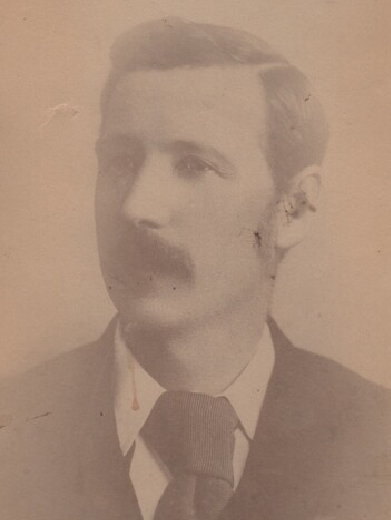
Arthur Loftus Maule Steele was a son of Captain Robert Ball Steele, of Rossylongan House, Donegal, Ireland. His father held the rank of Captain in the 6th Inniskillan Dragoons, and it was while the family were travelling in France that their son A. L. M. Steele was born at Tours, in 1839. He was therefore, 75 years of age at his demise. When he had reached the age of 12 he was sent to the Military Academy, Dublin, and there in the years following he passed his examinations and prepared to enter the British Army.
The Crimean War was then nearing its end, and his first appointment was to the Commissary Department, which in response to public criticism of the tragic blunders in the Crimea had been re-organised. He embarked and was on his way to the seat of war when on arrival at Gibraltar the news came that peace had been declared. Mr. Steele received orders to return to Ireland.
Later he met there a brother of Mr. O’Hara Bourke (of the Bourke and Wills expedition) who advised him to go to Australia, from which the stirring news of gold discoveries had just come, and join the Police there as a cadet. He took the advice, and retired from the service; but on board the ship met Superintendent Langlay, who told him that the Cadet system in the Victorian police force had been abolished, and that he would have to join the ranks. This he would not then do. As a lad of 17 he, on his arrival in Melbourne, entered the office of the White Star line as a clerk, a post for which a sound education had well fitted him.
He soon tired of office work and in 1856 entered the service of the Victorian Police. For some years he did escort service from Runnymede and other gold centres and in 1863 was appointed to Omeo as Senior Constable in charge. In 1864 he was married at Snowy Creek, by the Rev. Mr. Dowell to Miss Ruth Ingram Ballinger, of Gloucestershire, England, who had only arrived in the colony a few months before. He performed the police duties at Omeo with tact and ability, and was soon promoted to the mining centre of Beechworth, taking charge of the Yackandandah station. Here he was at once plunged into the free and reckless life of the goldfields, and maintained throughout the excellent reputation he had always made as a steady and intelligent police officer.
He was a police officer who, in other times, must have risen very high in the service. There is no doubt he was at one time kept back by the jealousy of inferior men until he had reached an age when promotion made little or no appeal. He was a handsome man, in his face the indelible stamp of race, and in all his actions and bearing a certain consciousness of the value of life and duty. On horseback, and he was a fine horseman, he made a gallant figure about thirty years ago, riding along Murphy street or over the bridge in the morning on his rounds or on some business of the day. A figure of old romance has passed away from Wangaratta — a true man, and at fine gallant spirit, who did his duty without fear and without favour. If he made mistakes they were not in the course of his duty; and no criticism could ever touch his conduct or his personal honour.
He had a keen appreciation of the natural beauty of the North-East, and in congenial company could tell in clear, precise words story after story of adventure in the early days of the gold fields, and in more lawless times — amongst the mountains in pursuit of law breakers.
We do not know if he left any records; we doubt it. But he was a mine of information about the North- East, and had such a clear memory of the details that make a story really interesting that if he had written the account of his life it must have been good reading.
Sergeant Steele was not only a gallant figure in the life of the Town; in all parts of the Empire where the Police Force is on duty his name is associated with the final scene in the drama of the Kellys. The late Sergeant Steele also took a very considerable interest in the culture of flowers; and was an extensive prize winner at Wangaratta and district shows.
He was one of the oldest members of St. John’s Lodge of Masons, Wangaratta, being a Past Master, and held the office of treasurer for over thirty years. He was a regular attendant at meetings, He was a staunch adherent of the Church of England, and was a member of the Vestry for many years, He also held the position of Electoral Inspector for Wangaratta.
Reference
Wangaratta Chronicle Wed 11 Feb, 1914, Page 3 DEATH OF SERGEANT STEELE